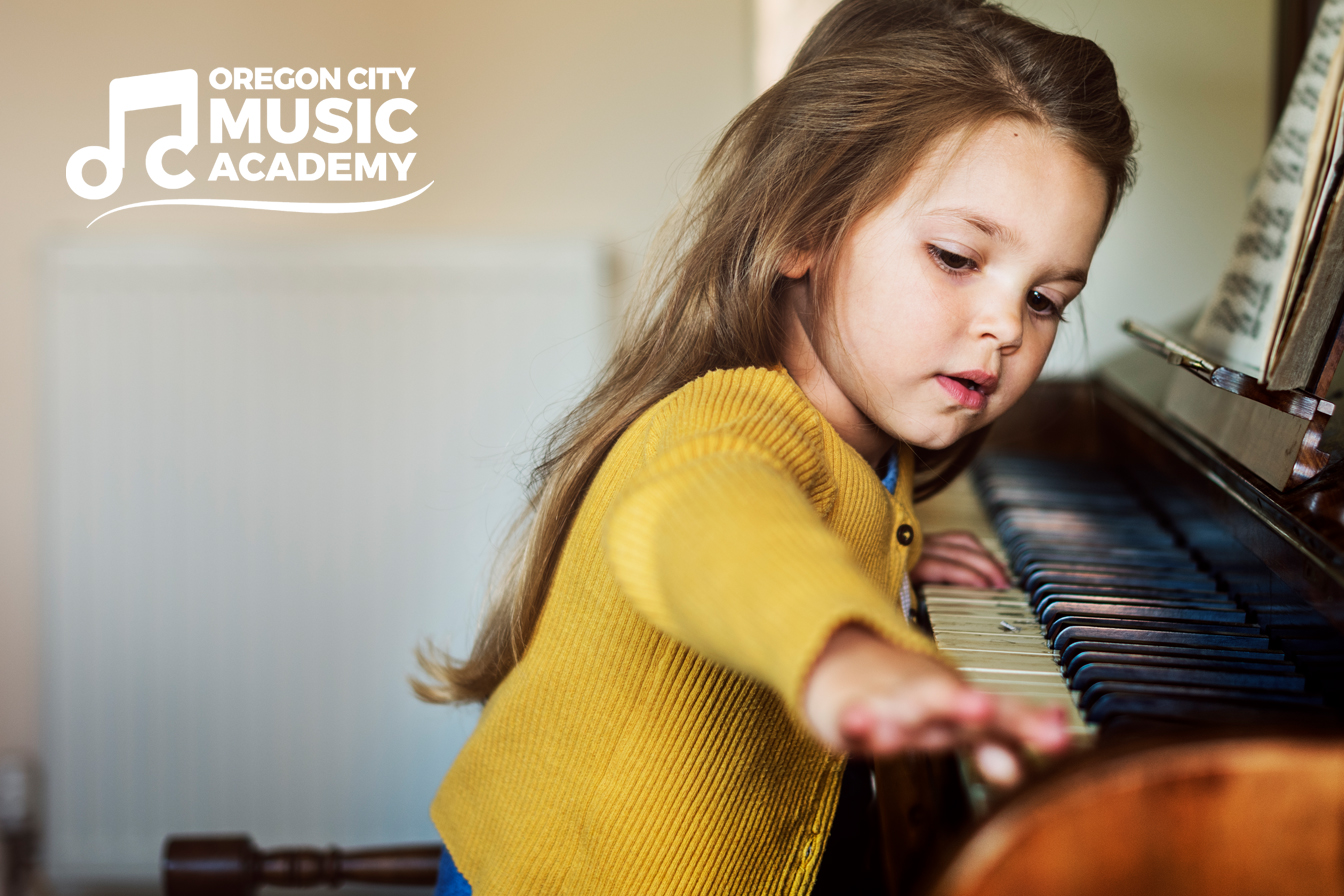
A child says they want to learn music, and the first instinct is often to start comparing instruments.
Should we choose piano because it teaches the fundamentals?
Would guitar keep them more interested?
Is six too young?
Should we wait and see what they play at school?
These are reasonable questions. But at Oregon City Music Academy, there is another question we think deserves to come first:
What kind of music actually makes this student curious?
That may sound simple, but overlooking it is one of the biggest mistakes families can make when choosing a first instrument.
Around Oregon City, we meet students with completely different personalities and reasons for wanting to play. A child coming from Park Place may have spent months asking for a guitar because of the music they listen to with their parents. Another student from Hillendale might sit down at every piano they encounter. A teenager from the Beavercreek area may already be singing constantly but has never thought of their voice as an instrument worth studying.
There isn’t one correct starting point for all three.
And there shouldn’t be.
Piano Is a Great First Instrument, but It Isn’t a Requirement
There’s a reason piano is frequently recommended to beginners.
The layout is visual. Press a key and you immediately produce a clear note. Musical relationships that can seem abstract on other instruments are literally sitting in front of the student.
Piano can be an outstanding introduction to music.
The mistake is turning “piano is a good first instrument” into “everyone should learn piano first.”
Imagine a student who spends every car ride listening to guitar music. They notice guitar parts in songs. They pretend to play along at home. When they see a live band, they’re watching the guitarist.
Then an adult tells them they need to spend a year learning piano first because it’s more educational.
Musically, there may be logic behind that recommendation.
Motivationally, we may have just taken the thing that excited the student and moved it farther away.
That’s a poor trade.
Watch What Your Child Does When Nobody Is Directing Them
Children often tell us which direction they’re leaning without ever formally announcing it.
One taps rhythms on the kitchen counter.
Another sings constantly.
One gravitates toward keyboards.
Another wants to know how guitar players make different sounds.
Those behaviors are worth noticing.
Interest doesn’t guarantee that an instrument will be easy. It doesn’t mean a child will happily practice every day. And it certainly doesn’t eliminate the frustrating parts of learning.
What it does provide is a reason to work through those frustrating parts.
That’s valuable.
When families explore our music lessons by instrument, we want them thinking about the student as much as the instrument.
A Good Match Doesn’t Mean an Easy Match
This distinction matters.
Parents understandably want a positive beginning. Nobody wants their child to spend the first month feeling defeated.
But the best instrument isn’t necessarily whichever one creates the easiest first few lessons.
Every instrument eventually pushes back.
Guitar students discover that clean chord changes take work.
Piano students reach music that demands independence between the hands.
Singers learn that using the voice well involves far more technique than simply knowing the melody.
Students eventually meet something they can’t do yet.
That’s not evidence that the wrong instrument was chosen.
That’s music education.
A better measure is what happens next.
Does the student remain curious enough to try again?
The Right Answer May Change With Age
A six-year-old and a sixteen-year-old shouldn’t necessarily go through the same instrument-selection process.
Younger students may need more guidance from parents and teachers. Physical development, attention span, and the ability to follow instruction all matter.
Older students often arrive with much stronger opinions.
By middle school or high school, students may already know the artists they love, the sounds they want to make, or the kind of musician they imagine becoming.
That’s useful information.
It’s also one reason private music instruction shouldn’t be viewed only as something for young beginners.
An older beginner can bring tremendous motivation into lessons because the decision to learn is increasingly their own.
Intermediate students are different again. They may not need help choosing an instrument at all. They need a teacher who can recognize where they’ve reached and show them that there is much more beyond the basics.
What If My Child Changes Their Mind?
This is where parents sometimes get nervous.
A student wants guitar. Three months later, piano suddenly looks interesting.
Does that mean the original decision was wrong?
Not necessarily.
Exploration is part of becoming musical.
At the same time, there is a difference between discovering a genuine new interest and wanting to switch instruments every time something becomes difficult.
That distinction is hard for a parent to judge from the outside.
A student might say, “I don’t like guitar anymore,” when what they really mean is, “Barre chords are frustrating and I don’t like being bad at them.”
Those are very different problems.
One may call for exploring another instrument.
The other may call for a teacher helping the student get through a perfectly normal learning barrier.
This is where good instruction becomes more than simply assigning the next song.
Sometimes Parents and Students Want Different Things
This is another conversation worth having openly.
A parent may have loved piano growing up and picture their child having the same experience.
A student may want absolutely nothing to do with piano.
Neither perspective is ridiculous.
Parents bring experience and long-term thinking to the decision. Children bring personal curiosity.
The strongest choice usually respects both.
Parents should absolutely consider practical questions:
Can we support regular practice?
Is the instrument appropriate for the student’s age?
Can we realistically fit lessons into our routine?
But enthusiasm deserves a place at the table, too.
A technically perfect choice that a student doesn’t care about rarely remains perfect for very long.
Your First Instrument Isn’t a Lifetime Contract
Fortunately, this decision isn’t as permanent as it sometimes feels.
Musicians change instruments.
Pianists learn guitar.
Guitarists become singers.
Singers learn enough piano to accompany themselves.
Students join school ensembles and discover instruments they had barely considered before.
What they learned on the first instrument doesn’t disappear.
They bring rhythm, listening, practice habits, musical vocabulary, and confidence with them.
The first instrument is a doorway into music, not a decision that closes all the other doors.
How Teachers Know When the Match Is Working
Parents often look for obvious signs of progress:
How many songs can they play?
Are they reading music yet?
Are they getting better quickly?
Teachers notice other things.
We notice when a student starts correcting a mistake without being prompted.
We notice when they ask why something sounds the way it does.
We notice when they arrive wanting to show us something they figured out between lessons.
We notice when a difficult passage frustrates them, but they stay with it.
Those moments don’t look as impressive as a polished performance.
They may be more important.
They show that the student is beginning to take ownership of music.
That’s when we’re no longer simply teaching someone where to put their fingers.
We’re helping develop a musician.
Start With the Student, Not the Instrument
For families in Oregon City, Redland, Park Place, Hillendale, and the surrounding communities, choosing music lessons doesn’t have to begin with figuring out which instrument is supposedly “best.”
Start by watching.
What music gets your child talking?
What sounds do they notice?
What instrument do they keep coming back to?
What would they be genuinely excited to learn?
Then bring the practical questions into the conversation.
At Oregon City Music Academy, we work with complete beginners as well as intermediate and advancing students, because there is no single correct doorway into music and no single finish line once a student begins.
If your family is considering lessons and isn’t sure where to start, contact OC Music Academy. Choosing an instrument should begin with understanding the person who is going to play it.