
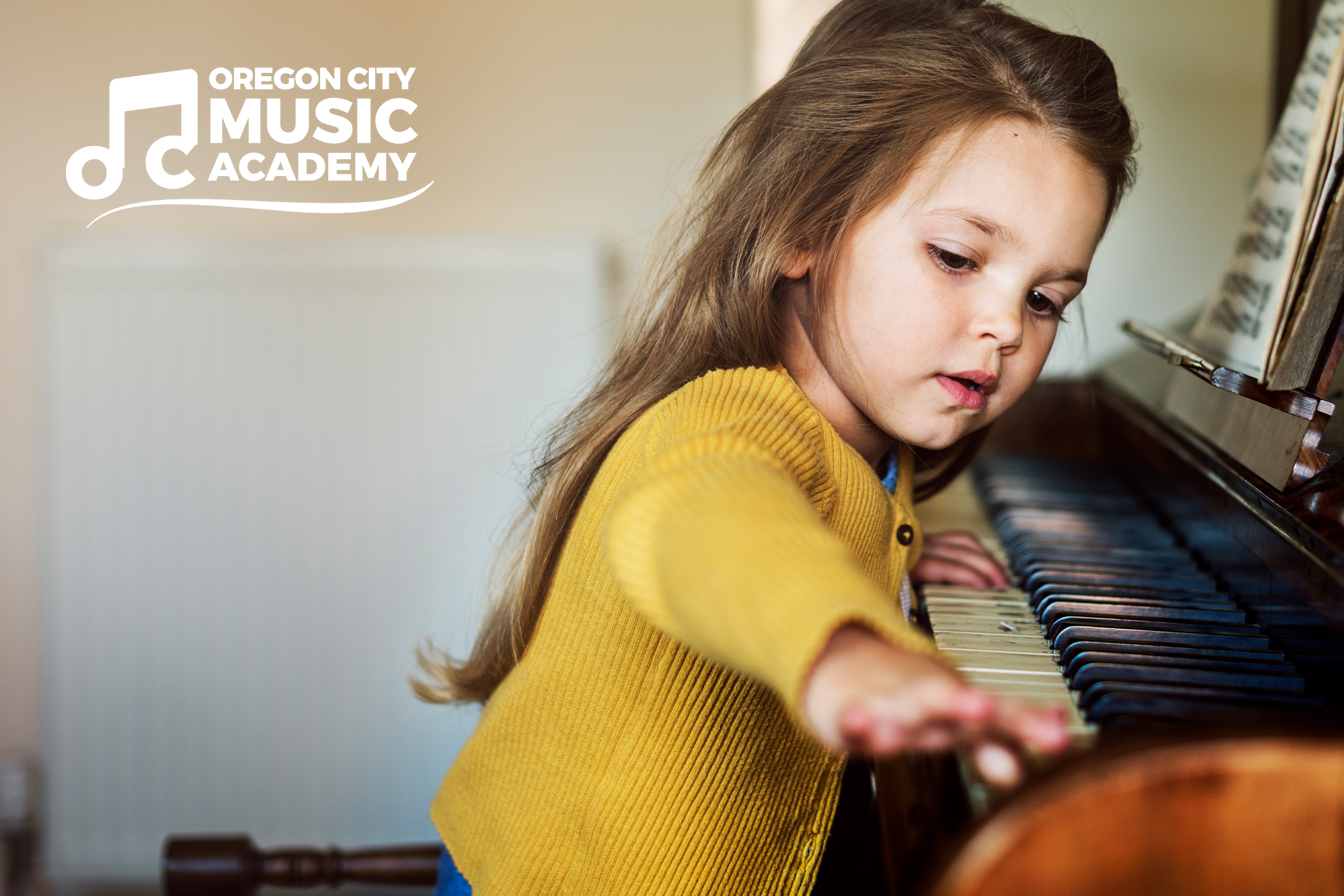
A parent hears the unfinished song.
A music teacher may hear something completely different.
We hear the student correct a rhythm without being prompted.
We notice that they kept playing after hitting the wrong note instead of immediately stopping.
We see them look at a difficult passage, think for a moment, and try a different approach.
None of those moments are likely to earn applause. They probably won’t be recorded and sent to grandparents. They aren’t the obvious milestones families naturally use to measure progress.
But they tell us a great deal about where a student is headed.
At Oregon City Music Academy, one of the interesting parts of teaching is watching musical growth happen before it becomes particularly noticeable from the outside.
For parents in Gresham wondering whether lessons are “working,” especially once a child moves beyond the rapid gains of the beginner stage, it helps to understand what a teacher is actually watching.
It isn’t always the finished song.
We Notice What Happens Immediately After a Mistake
Listen to a beginning student make a mistake and you’ll often hear this:
Stop.
Start over.
Make another mistake.
Stop.
Start over again.
Sometimes they never make it past the first eight measures because they’re trying to create a perfect run from beginning to end.
Over time, something changes.
A student misses a note and keeps going.
That may not sound like progress to someone listening from another room. To a teacher, it can be a major development.
The student is learning that music doesn’t collapse because one note went wrong.
That matters for performance. It matters for playing with other musicians. It matters for confidence.
Eventually, we want students to know both how to correct a mistake during practice and how to recover from one when stopping isn’t an option.
Those are two different musical skills.
We Notice When Students Start Hearing Their Own Problems
Early on, teachers do much of the noticing.
“Listen to that rhythm again.”
“Your hand changed position there.”
“Did you hear what happened during that chord?”
The student depends on the teacher’s ears.
Then one afternoon, the student stops and says:
“That didn’t sound right.”
That sentence is music to a teacher’s ears.
It means the student’s listening ability is catching up with their playing ability.
This is a major step toward independence.
A teacher can’t sit beside a student every time they practice at home in Downtown Gresham, Pleasant Valley, Centennial, or anywhere else across East County. Eventually, students have to become capable of evaluating themselves.
The moment they begin hearing problems independently, practice becomes much more productive.
We Pay Attention to the Questions Students Ask
Questions reveal where a student’s mind is.
A beginner may ask:
“Which finger goes here?”
That’s exactly the question we’d expect.
Later, the questions become more interesting.
“Why does this chord work here?”
“Could I play this another way?”
“Why does the original recording sound different?”
“Can I make this part quieter?”
Those aren’t simply requests for instructions.
They’re signs of curiosity.
The student is beginning to investigate music rather than merely complete assignments.
For intermediate and advanced students, that shift is particularly important. At some point, progress has to become more than doing what the teacher says each week.
Students need opinions.
They need curiosity.
They need to care how something sounds.
We Notice When Practice Leaves Fingerprints
Teachers can usually tell when productive practice has happened.
Not because the piece is suddenly perfect.
Often, it isn’t.
Instead, something specific has changed.
A difficult transition is cleaner.
The rhythm that caused trouble last week is more stable.
The student has clearly experimented with a fingering.
Maybe they fixed one problem but uncovered another.
That’s fine.
Good practice doesn’t always arrive at the lesson as a polished product. Sometimes it arrives as evidence that the student has been thinking.
That’s one reason simply asking, “Did you practice?” doesn’t tell the whole story.
A more revealing question is:
“What did you figure out?”
We Notice Independence Before Parents Usually Hear It
One of the most important changes in music education is also one of the quietest.
Students begin needing us differently.
A young beginner may need instruction at nearly every step.
An advancing student starts arriving with work already underway.
They may say:
“I tried this fingering, but I don’t think it’s working.”
Or:
“I can play this section slowly, but it falls apart when I speed it up.”
Now we have something much more interesting to work with.
The student has diagnosed part of the problem before the lesson even begins.
That’s not just improvement on an instrument.
That’s learning how to learn.
Our music lessons by instrument are meant to develop that independence over time, not create students who can only progress when a teacher is sitting beside them.
We Notice When a Student Stops Being Afraid of Difficult Music
There is often a visible reaction when beginners see something challenging.
Too many notes.
An unfamiliar rhythm.
A chord they haven’t played before.
The immediate response can be:
“I can’t do that.”
Months or years later, the reaction changes.
The music is still difficult, but instead of rejecting it, the student begins examining it.
They may slow it down.
Break it into sections.
Ask a question.
Try one hand at a time.
That change is enormous.
The student hasn’t simply become better at piano, guitar, voice, or another instrument.
They’ve developed evidence that difficult things can become manageable.
Parents Often Hear the Plateau. Teachers See the Construction
This becomes especially relevant after the beginner stage.
Early musical progress can be wonderfully obvious.
Last month, the student couldn’t play a chord. Now they can.
They couldn’t read these notes. Now they can.
Then progress becomes harder to hear.
An intermediate student may spend weeks improving tone, control, timing, articulation, or interpretation. To someone waiting for the next dramatically harder song, it can look as though very little is happening.
Teachers know better.
It’s a bit like watching a house during the stage when most of the work is happening inside the walls. The exterior may look almost unchanged from one afternoon to the next.
That doesn’t mean nothing is being built.
We Notice When Students Bring Their Own Music Into the Room
There is another moment teachers love.
“Can we work on this?”
Maybe it’s a song they heard online.
Maybe a Gresham High School student wants help with music for an ensemble.
Maybe a younger student heard something at home and became fascinated by it.
This matters because the direction of interest has changed.
Music is no longer traveling only from teacher to student.
The student is bringing music back.
That is often the beginning of a much more personal relationship with their instrument.
A strong teacher can use that interest without abandoning fundamentals. Technique and student choice don’t have to compete.
In good lessons, they inform each other.
We Notice Confidence Before It Looks Confident
Confidence in music is frequently misunderstood.
It isn’t always a student eagerly volunteering to perform in front of a crowd.
Sometimes confidence looks like trying again without being asked.
Sometimes it’s admitting, “I don’t understand this.”
Sometimes it’s playing through a mistake.
Sometimes it’s choosing a harder piece even though the student knows it will take time.
Quiet students can be deeply confident musicians.
Outgoing students can still be terrified of making mistakes.
Teachers learn to look beneath personality.
So, How Should Parents Measure Progress?
Listen for the songs, certainly.
Celebrate the recital.
Notice when a piece that once sounded impossible becomes comfortable.
Those milestones are worth enjoying.
But don’t let them become the only scoreboard.
Also look for the student who:
- Works through frustration differently than they did six months ago
- Notices their own mistakes
- Practices with more purpose
- Asks better questions
- Needs fewer reminders
- Becomes curious about music outside the lesson
- Tackles difficult material without immediately backing away
Those changes are easy to miss.
They may also be some of the best evidence that lessons are doing exactly what they should.
Developing Musicians, Not Just Finishing Songs
Families searching for music lessons in Gresham naturally want to know that their time and effort are producing results.
We think they should expect progress.
But progress deserves a broader definition than the number of songs completed.
At Oregon City Music Academy, the long-term goal is to help students become increasingly capable musicians—students who can listen, think, practice, solve problems, express ideas, and eventually take greater ownership of their own development.
Sometimes parents hear that growth immediately.
Sometimes the teacher sees it first.
If you’re looking for instruction that can meet a student at the beginner level and continue challenging them as their musicianship develops, contact OC Music Academy to learn more about lessons.